
openai-whisper (Local) Speech Recognition
Overview
This is the official open-source Whisper model from OpenAI. Compared to faster-whisper, it is slower but slightly more accurate. If you need higher recognition precision and don't mind slower processing, this channel is a good choice.
Key differences from faster-whisper:
| Comparison | openai-whisper | faster-whisper |
|---|---|---|
| Recognition speed | Slower | Fast (several times faster) |
| Accuracy | Slightly higher | Slightly lower |
| Model format | .pt files | Folder structure (.json/.bin/.txt) |
| Download source | OpenAI official CDN | HuggingFace |
| Model size | Comparable to faster-whisper | Comparable to openai-whisper |
Key advantages:
- Runs entirely locally — audio files are never uploaded to the internet
- Slightly higher accuracy than faster-whisper
- Models downloaded from OpenAI's official CDN, relatively stable access worldwide
- Auto-downloaded on first use, then fully available offline
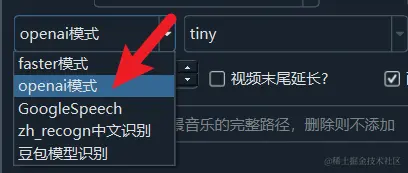
Prerequisites
Before using openai-whisper, please confirm the following requirements:
| Requirement | Details |
|---|---|
| Disk space | At least 5–15 GB reserved for model files (larger models need more) |
| RAM | Basic models (tiny/base) require 4 GB+; large series requires 16 GB+ |
| GPU (optional) | NVIDIA GPU + CUDA acceleration provides significant speedup; large-v3 requires 10 GB+ VRAM |
| Network | Internet required on first use to download models; afterward, fully offline |
Model Selection
The first time you use a model, it will be automatically downloaded from openai-whisper's official CDN.
tiny --> base --> small --> medium --> large-v3-turbo --> large-v1 --> large-v2 --> large-v3
Models increase in size from left to right, with higher accuracy and greater memory/VRAM requirements.
It is recommended to use at least large-v3-turbo or larger. The best-performing model is large-v3.
Model Reference Table
| Model | Use Case | RAM | VRAM (CUDA) | Notes |
|---|---|---|---|---|
| tiny | Quick preview | 2 GB+ | 1 GB+ | Fastest, lowest accuracy |
| base | Simple content | 3 GB+ | 1 GB+ | Good for clear speech |
| small | General use | 4 GB+ | 2 GB+ | Balanced speed and accuracy |
| medium | Multilingual | 8 GB+ | 5 GB+ | Good multilingual performance |
| large-v3-turbo | Recommended starting point | 10 GB+ | 6 GB+ | Fast with high accuracy |
| large-v1 | High accuracy | 16 GB+ | 10 GB+ | Classic large model |
| large-v2 | High accuracy | 16 GB+ | 10 GB+ | Improved large model |
| large-v3 | Best results | 16 GB+ | 10 GB+ | Recommended — best overall |
Note: openai-whisper models are
.ptfiles, different from faster-whisper's folder structure. They are automatically saved in the software directory after download.
Optimal Configuration
For the best speech recognition results, follow these settings:
- Select model
large-v3(ensure your system has more than 16 GB RAM or more than 10 GB VRAM). If requirements aren't met, trylarge-v1orlarge-v3-turbo. - Explicitly set the speech language to match the language spoken in the video.
- In Menu → Tools → Advanced Options → Speech Recognition Parameters: set
Minimum speech duration (ms)to 1000,Maximum speech duration (s)to 5 or higher, and do not checkWhisper pre-split audio.
Important for voice cloning: If you plan to dub with the
clonerole (cloning the original speaker's voice), it is strongly recommended to setMinimum speech duration (ms)to 3000 andMaximum speech duration (s)to 10. This is because voice cloning uses the original audio segment corresponding to the subtitle duration as a reference, and most dubbing channels require this reference audio to be 3–10 seconds long — otherwise dubbing will likely fail. You should also checkWhisper pre-split audioandMerge short subtitles into adjacentto ensure subtitle durations fall within the 3–10 second range.
- If the original speech is unclear or has background noise, enable Noise Reduction.
- If you are not using the
clonerole and want shorter subtitles (e.g., for vertical video), you can lowerMaximum speech duration (s)to 3 or 2. If dubbing is enabled, you can also checkSecondary recognition.
Secondary recognition: When dubbing is enabled and embedded single subtitles are selected, checking this option means the software will re-transcribe the dubbed audio after dubbing is complete, generating shorter subtitles embedded in the video to ensure precise alignment between subtitles and dubbed audio.
CUDA Acceleration
To speed up processing, on Windows and Linux, if you have an NVIDIA GPU, you can install the CUDA and cuDNN environment and enable CUDA Acceleration in the software, which significantly improves execution speed.

View CUDA and cuDNN installation tutorial
CUDA Acceleration Setup Steps
- Confirm your NVIDIA GPU supports CUDA (GTX 10 series or newer)
- Download and install the corresponding version of CUDA Toolkit
- Download and install the corresponding version of cuDNN
- Enable
CUDA Accelerationin the software - Restart the software to apply the configuration
Model Download Information
openai-whisper models use the .pt format, different from faster-whisper's folder structure.
Automatic Download
The first time you use a model, the software automatically downloads the corresponding .pt model file from OpenAI's official CDN (openaipublic.azureedge.net). Once downloaded, it is cached locally and does not require internet access.
Manual Download
If automatic download fails, you can manually download the model files:
- Visit OpenAI's official model download page: https://github.com/openai/whisper/blob/main/whisper/__init__.py
- Find the download link for the corresponding model on the page
- Place the downloaded
.ptfile in the model cache folder inside the software directory
Model Storage Location
Model files are automatically saved in the software's runtime directory after download — no manual path configuration needed.
Common Issues and Troubleshooting
Download fails or gets stuck
Cause: Unstable network or inability to access OpenAI CDN.
Solutions:
- Check your network connection and ensure internet access
- If using a proxy, configure proxy settings correctly in the system
- Try downloading again during a period with better network conditions
- Download model files manually — see the "Manual Download" section above
Recognition results are blank or garbled
Cause: Model files downloaded incompletely or are corrupted.
Solutions:
- Delete the corresponding
.ptmodel file from the software directory and restart the software to re-download - Verify the model file is complete (file size should match the official specification)
Recognition is very slow
Cause: CUDA acceleration is not enabled, or the model is too large.
Solutions:
- Confirm CUDA and cuDNN are installed, and enable
CUDA Accelerationin the software - If you don't have an NVIDIA GPU, try a smaller model (such as
baseorsmall) - Verify your GPU VRAM meets the model's requirements
Out of memory (OOM)
Cause: The model is too large for available RAM or VRAM.
Solutions:
- Use a smaller model (e.g.,
large-v3-turboinstead oflarge-v3) - Close other memory-intensive programs
- Ensure at least 16 GB RAM when using large-series models
Wrong language detected
Cause: The speech language was not correctly specified.
Solutions:
- Explicitly set the speech language in the software to match the language in the video
- If the video contains multiple languages, try processing in segments
Choosing between faster-whisper and openai-whisper
If you're unsure which channel to choose, here are some recommendations:
- Prioritize speed: Choose
faster-whisperfor faster processing - Prioritize accuracy: Choose
openai-whisperfor slightly higher accuracy - First-time users: Start with
faster-whisperfor a better experience - Large model processing: The difference is minimal — choose based on personal preference